
Finding mental health support takes courage. Finding the right support takes a bit more knowing what questions to ask, what qualifications matter, and what the therapeutic relationship should actually feel like before you commit to the process.
This guide walks through the key factors to consider when searching for a trauma therapist, with practical guidance for anyone looking for care in Harrison, NY, or the surrounding Westchester County area.
In this blog we will discuss
- Start With Specialized Training
- What to Look For in a Trauma Therapist
- Consider the Practical Logistics
- Why Local Expertise Matters
- Questions Worth Asking Before You Begin
Start With Specialized Training
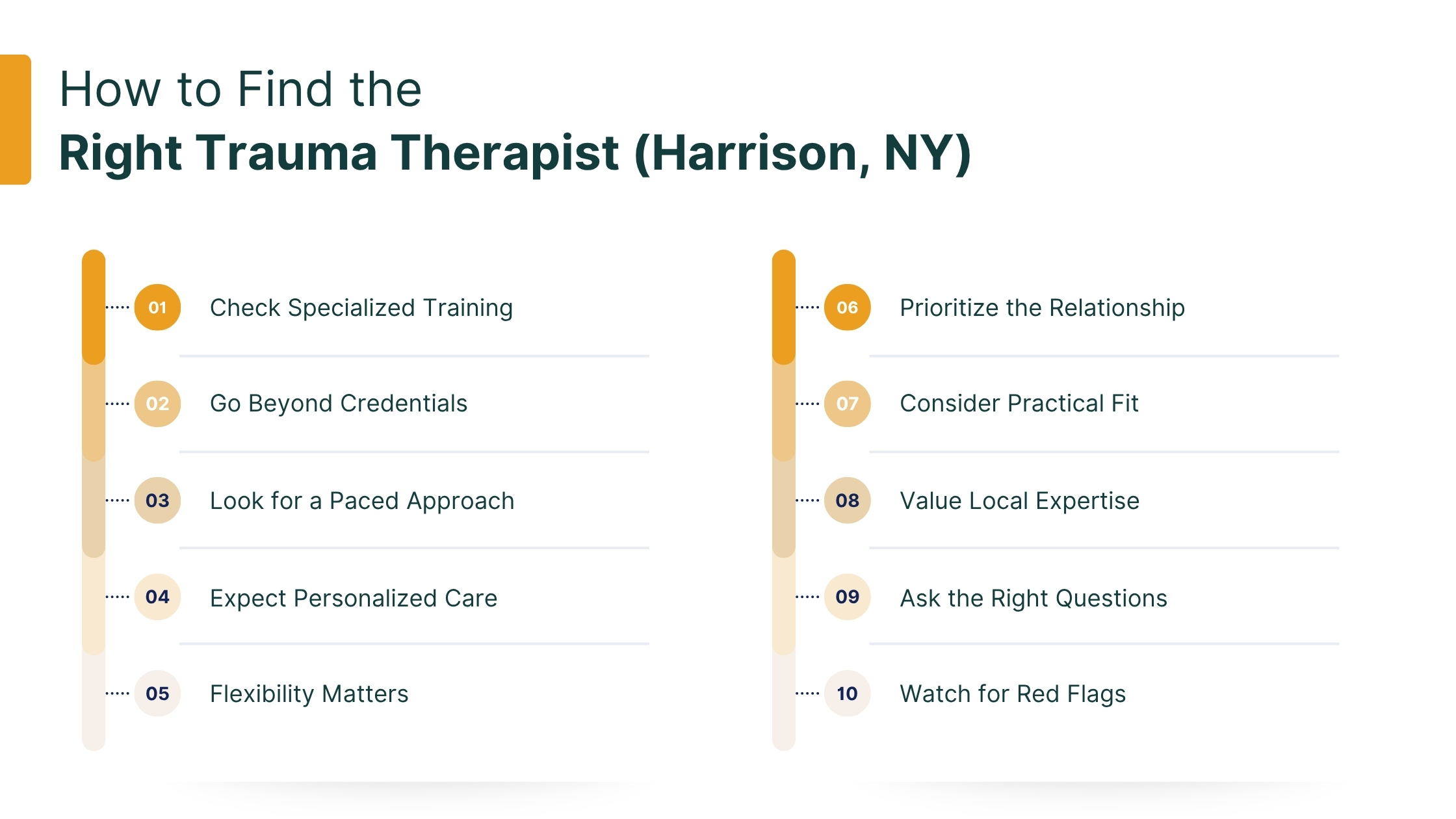
Not every licensed therapist is trained in trauma. General mental health credentials are valuable, but trauma therapy requires additional, specific preparation. When researching how to find a trauma therapist, your first filter should be training in trauma-specific modalities.
Look for clinicians with backgrounds in approaches like EMDR, trauma-focused cognitive behavioral therapy, somatic therapy, or psychodynamic methods oriented toward trauma processing. These are not interchangeable with general talk therapy. The training shapes the entire clinical approach, including how a therapist holds difficult material, paces the work, and tracks the client’s nervous system responses throughout treatment.
Credentials matter, but so does the depth of clinical experience behind them. A therapist who has spent years working with complex trauma cases brings something a recently licensed generalist cannot replicate.
What to Look for in a Trauma Therapist?
Knowing what to look for in a trauma therapist beyond the basics helps you make a more informed decision.
A phased, paced approach.
Effective trauma therapy does not rush into processing difficult memories. A qualified therapist will prioritize stabilization and safety first, building the internal resources needed before any deeper work begins. If a clinician pushes quickly into traumatic material without this foundation, consider that a concern.
Individualized treatment.
Trauma affects people differently. Your history, your nervous system, and your readiness all shape what the therapeutic process should look like. A rigid, one-size-fits-all approach is a poor fit for trauma work specifically.
Capacity to integrate multiple modalities.
The most effective trauma clinicians are not limited to a single technique. The ability to draw on psychotherapy, psychoanalytic insight, and, when appropriate, medication support gives the clinician more tools to meet the individual where they are.
A therapeutic relationship built on trust.
Research on trauma treatment consistently points to the therapeutic alliance as one of the strongest predictors of outcome. How you feel in the room or on the screen matters. Safety, respect, and consistency are clinical necessities, not optional extras. That’s why patients return to Dr. Fontane for long-term mental health care.
Consider the Practical Logistics
The best clinician in the world is not effective if the logistics make consistent attendance impossible. When evaluating a trauma therapist near Harrison NY, factor in the following:
Location and access.
In-person appointments work well for many people. Virtual options expand access significantly, particularly for those with demanding schedules, mobility limitations, or a preference for working from home.
Insurance and cost.
Financial barriers are a real obstacle to care. A clinician who accepts insurance and is transparent about fees makes it easier to prioritize treatment without ongoing stress about affordability.
Availability and consistency.
Trauma therapy depends heavily on regularity. A therapist with limited availability makes it harder to build the continuity the process requires.
Why You Should Consider Local Expertise?
Local clinicians often have established relationships with other providers, familiarity with community resources, and availability for in-person appointments when that format serves the client better.
There is also something meaningful about working with a clinician genuinely embedded in a community rather than operating solely through a national telehealth platform. The therapeutic relationship benefits from that kind of rootedness.
Questions Worth Asking Before You Begin
Before committing to a therapist, consider asking:
- What specific training do you have in trauma treatment?
- How do you approach the early stages of trauma therapy?
- How do you adjust your methods if something is not working?
- Do you coordinate with other providers, such as psychiatrists or primary care physicians?
- What does a typical treatment timeline look like for someone with my concerns?
The answers and just as importantly, how the clinician responds to being asked will tell you a great deal.
Final Thoughts: Trauma Therapist Westchester County NY
For those ready to take the next step, Dr. Barbara Fontane offers personalized psychiatric and psychotherapeutic care at 600 Mamaroneck Avenue in Harrison, NY. With over 20 years of clinical experience and psychoanalytic training through the Contemporary Freudian Society of New York, her approach addresses the deeper roots of trauma rather than surface-level symptoms alone. Virtual and in-person appointments are available across Westchester County. Dr. Fontane accepts insurance and tailors every care plan to the individual.