Managing ADHD, OCD, or both together in adulthood is not simply about symptom control.
It requires understanding how these patterns interact and how treating one condition without addressing the other can sometimes create new challenges. Many adults eventually ask: can you have adhd and ocd at the same time? Yes. And when ADHD and OCD occur together, treatment becomes more nuanced. Modern care now focuses on treating both conditions at the same time rather than separately.
Why Combined Treatment Matters
To begin with, it helps to understand: are adhd and ocd connected
They are distinct conditions, yet they often overlap in ways that influence behavior, emotional regulation, and decision-making. This overlap becomes clearer when looking at ocd and adhd symptoms.
- ADHD may involve difficulty sustaining attention or managing impulses.
- OCD may involve intrusive thoughts followed by repetitive actions meant to reduce distress.
Understanding what is the difference between adhd and ocd helps guide treatment.
- ADHD disrupts focus and consistency.
- OCD creates cycles of doubt and control.
When both are present, untreated ADHD can interfere with therapies designed for OCD, while OCD-driven anxiety can intensify ADHD-related overwhelm.
This is why modern adhd and ocd treatment focuses on integrated strategies.
Core Strategy 1: Cognitive Behavioral Therapy with ERP
One of the most effective approaches involves Cognitive Behavioral Therapy adapted for both conditions. For OCD, Exposure and Response Prevention (ERP) remains the gold standard.
It works by helping individuals face fears without performing compulsive behaviors.
For ADHD, CBT is modified to improve:
- Organization
- Executive functioning
- Time awareness
This dual adaptation supports progress on both fronts rather than isolating one condition.
Core Strategy 2: Tailored Medication Management
Medication plays an important role when carefully planned.
Thoughtful use of medication for ocd and adhd often includes:
- SSRIs for OCD
- Stimulants or non-stimulants for ADHD
Choosing the best medication for ocd and adhd is highly individualized.
Stimulants may sometimes intensify OCD symptoms, yet in certain cases they can reduce impulsivity that fuels compulsive cycles.
This is why understanding how to treat adhd and ocd at the same time requires careful monitoring rather than standard prescriptions.
Core Strategy 3: Specialized Therapies
Newer therapy models are expanding treatment possibilities.
Inference-Based Cognitive Behavioral Therapy focuses on the reasoning patterns that generate obsessive doubt.
Acceptance and Commitment Therapy helps individuals live meaningful lives even when symptoms are present.
Both approaches shift the goal from eliminating thoughts to changing how individuals relate to them.
Core Strategy 4: Neuromodulation for Resistant Cases
When traditional therapy and medication are not sufficient, advanced options may be considered.
These include:
- Transcranial Magnetic Stimulation
- Deep Brain Stimulation
These methods are typically reserved for treatment-resistant situations and are used under specialist care.
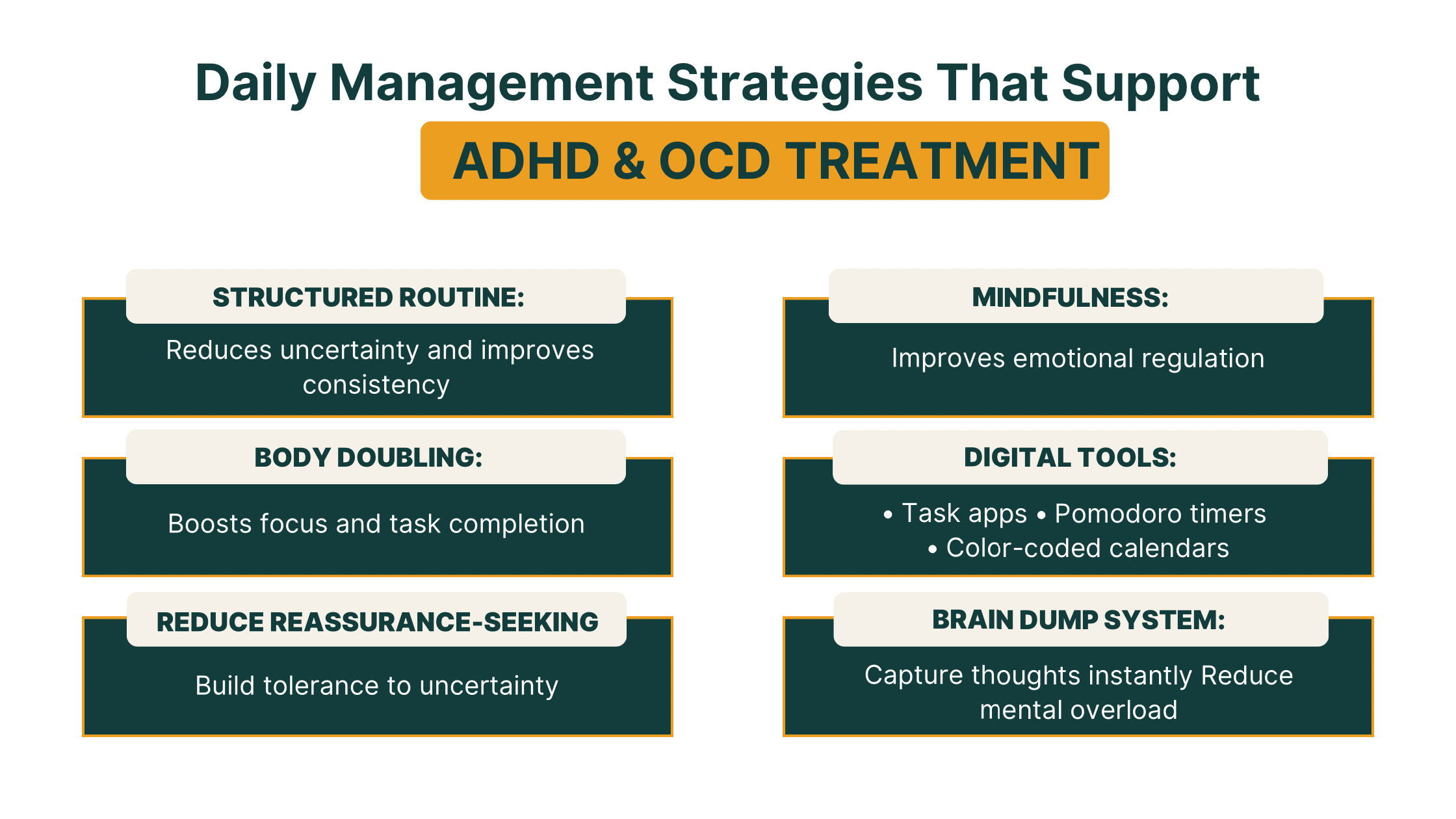
Daily Management Strategies That Support Treatment
Beyond clinical interventions, daily structure plays a powerful role.
-
Structured Routines
Consistent schedules reduce uncertainty that fuels OCD and provide the predictability ADHD often lacks.
-
Mindfulness Practices
Mindfulness and meditation improve emotional regulation and reduce the intensity of intrusive thoughts.
-
Body Doubling
Working alongside another person can improve focus and accountability. This simple strategy is particularly useful for ADHD-related task completion.
-
Digital Support Tools
Task management apps, timer-based systems, and color-coded calendars help organize attention and reduce overwhelm.
-
Reducing Reassurance-Seeking
Limiting reassurance-seeking behaviors helps build tolerance for uncertainty, an important step in managing OCD.
-
Brain Dump Systems
Using notebooks or voice notes to capture intrusive thoughts or ideas reduces mental clutter and improves clarity.
Challenges in Combined Treatment
Managing both conditions together is not without complexity. Untreated ADHD can reduce the effectiveness of ERP therapy. Diagnostic delays are common, with some individuals waiting years before seeking help. Medication sensitivity also varies. Stimulants may increase anxiety in some cases, while SSRIs may not fully address ADHD-related cognitive concerns.
Conclusion
The most effective approach to managing ADHD and OCD in adulthood is a personalized care plan created with a specialist familiar with both conditions.
Integrated strategies that combine therapy, medication when appropriate, and structured daily practices offer the strongest foundation for long-term progress.
For individuals in Westchester County seeking this level of care, working with an experienced ADHD psychiatrist can make a meaningful difference.
At her Harrison, New York practice, Dr. Barbara Fontane brings over 20 years of clinical experience and more than 4,200 sessions of patient care to her work. As an ADHD psychiatrist Westchester NY, she offers psychotherapy, psychoanalysis, and medication management tailored to each individual’s needs.
Her approach supports both symptom stability and deeper emotional understanding through virtual and in-person care, helping adults move toward lasting well-being.