Overview
Booking a first psychiatric appointment can bring up a lot of questions, and that uncertainty is often the hardest part. This blog walks through what actually happens during a first medication management appointment in Westchester County, from the intake conversation to building a treatment plan that fits your life. It covers how providers review your history, what to bring, how often follow-ups happen, and how medication management works alongside therapy. The goal is simple: to replace guesswork with a clear picture of the process, so you can walk in feeling prepared instead of anxious.
Table of Contents
- Introduction
- What Happens During the Visit
- The Intake Conversation
- Reviewing Your History
- Building a Collaborative Treatment Plan
- Follow-Up and Ongoing Support
- How to Prepare
- Who Can Benefit From Medication Management
- Combining Medication Management With Therapy
- Finding Medication Management Services in Westchester County
- Final Thoughts
- FAQ
Introduction
Why does that first appointment feel so big? There is a particular kind of nervousness that comes with booking your first psychiatric appointment. Maybe you have spent weeks rehearsing what you will say. Maybe you have googled your symptoms more times than you would like to admit. Maybe the idea of taking anxiety medication or depression medication feels like admitting something you are not ready to name out loud yet.
Here is what I want you to know before you even walk through the door: this visit is not a test you can fail. It is a conversation, and it is the first real step toward feeling like yourself again.
What Happens During the Visit
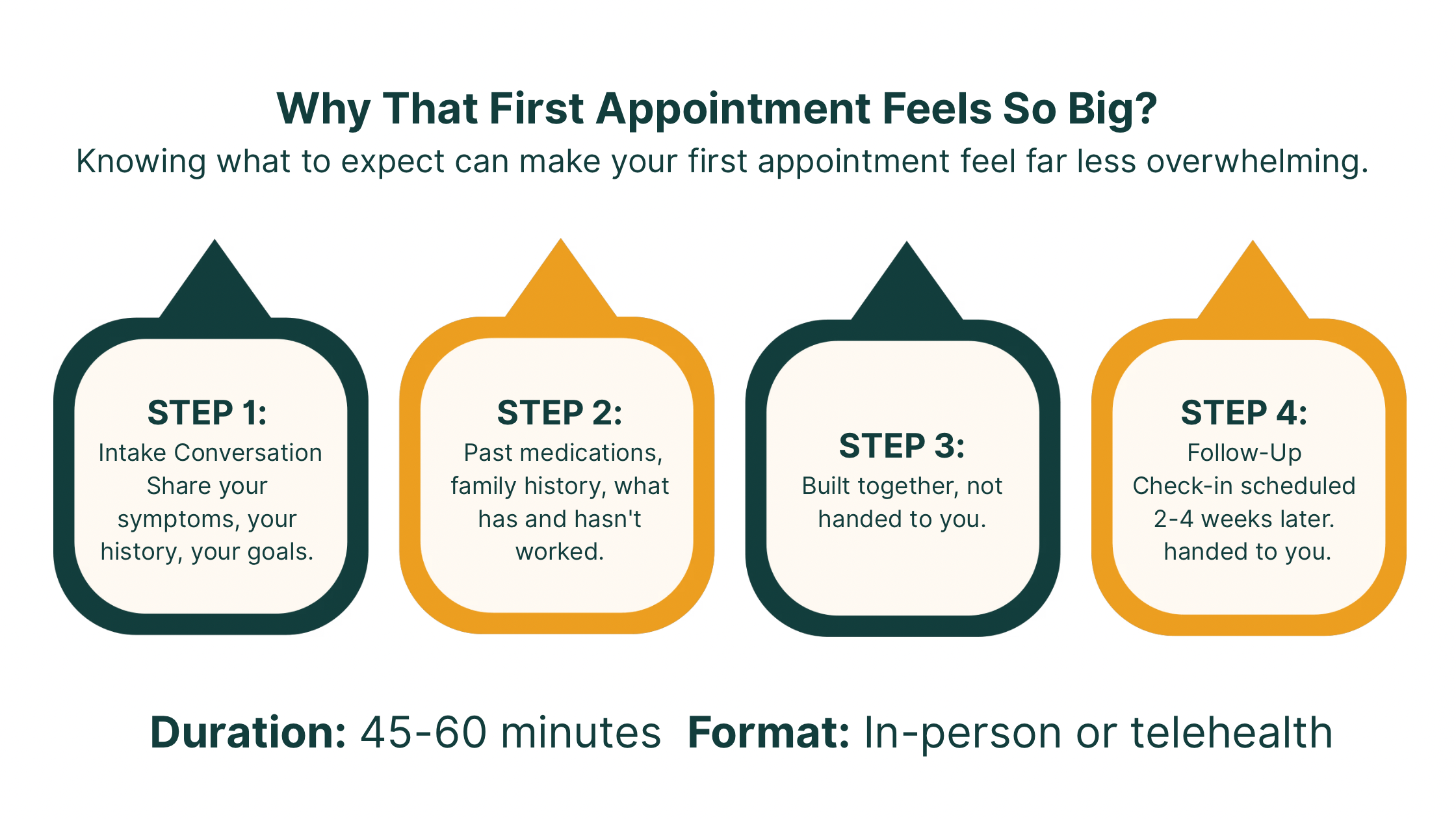
A first medication management appointment typically lasts 45 to 60 minutes and is led by a psychiatrist or psychiatric nurse practitioner. It is longer than a typical doctor’s visit on purpose. Mental health does not fit into a fifteen-minute slot, and neither does your story.
During this time, your provider will walk you through an initial evaluation, ask about your history, and talk with you about your goals. Nothing happens in a rush. You will not be handed a prescription the moment you sit down. Instead, the appointment is built around understanding you first and treating you second.
The Intake Conversation
This is where the real listening begins. Your provider will ask about your current symptoms, what a hard day actually looks like for you, and how those symptoms are affecting your work, your relationships, and your sense of yourself. You might talk about sleepless nights, racing thoughts, a heaviness that will not lift, or moments where everything feels like too much.
You do not need to have the right words ready. Providers trained in mental health medication management know how to ask questions that help the picture come into focus, even when you are struggling to describe what you are feeling.
Reviewing Your History
Next comes a review of your medical background, family mental health history, and any medications or therapy you have tried before. This part matters more than people expect. Knowing what has and has not worked for you, or for people in your family, helps your provider avoid repeating dead ends and points toward options that are more likely to help.
If you have tried a medication management with a psychiatrist in the past and it did not go well, this is the moment to say so. That history is not a failure. It is information.
Building a Collaborative Treatment Plan
By the end of the intake, your provider will outline a working diagnosis and talk through your options together with you. This might include starting a new prescription, or it might not. Some patients begin medication management for depression or medication management for anxiety on day one. Others need more conversation, more history, or a therapy referral before medication makes sense.
What matters is that the decision is made together. You are not handed a plan. You help build it, based on what fits your body, your life, and your comfort level.
Follow-Up and Ongoing Support
A brief follow-up is usually scheduled two to four weeks after your first visit. This gives your provider time to check in on how you are tolerating any new treatment, adjust dosages if needed, and answer questions that tend to surface once you have had a little time to sit with the changes.
Consistent medication management works the same way: one visit building on the next, with your provider learning more about what works for you over time.
How to Prepare
A little preparation goes a long way in making your first appointment feel manageable rather than overwhelming.
Start by writing down a complete list of everything you currently take, including prescription drugs, over-the-counter items, and any herbal supplements. Add notes on when your symptoms started, what tends to trigger them, and what you are hoping treatment will help you achieve. Bring your photo ID, your insurance card, and any past mental health or medical records you have access to.
None of this needs to be polished. A few honest notes scribbled on your phone are enough to help your provider understand your story faster and more accurately.
Who Can Benefit From Medication Management
Medication management is not reserved for any single diagnosis. It supports people managing depression, generalized anxiety, panic disorder, OCD, bipolar disorder, and adjustment difficulties tied to major life changes. It also supports adolescents working through emotional or behavioral challenges, and families sorting through conflict or parenting concerns.
Beyond mood and anxiety disorders, medication management can help people dealing with substance misuse, anger that feels hard to control, or the psychological weight of a serious medical diagnosis like cancer or another chronic illness. It also plays a role in pre-surgical psychological evaluations, including those required for bariatric surgery candidates, and offers inclusive, culturally sensitive support for LGBTQ+ individuals and survivors of domestic violence.
Combining Medication Management With Therapy
One of the most common questions patients ask is whether medication management replaces therapy. It does not, and it is not meant to. The strongest results usually come from combining evidence-based psychiatry with psychodynamic talk therapy, so that symptoms are addressed while the deeper, root causes behind them are also being explored.
For patients seeking that deeper insight, contemporary Freudian psychoanalysis offers a way to understand unconscious patterns that shape behavior long after symptoms have eased. If anxiety has been part of your story for a while, this piece on medication management and psychotherapy for anxiety explains how the two approaches work side by side, and what tends to change once treatment begins.
Finding Medication Management Services in Westchester County
If you are searching for medication management near me, it helps to know that care today does not have to mean choosing between convenience and quality. Appointments are available both in person and through secure virtual telehealth sessions, so patients across Westchester County, New York City, and the surrounding areas can access care that fits their schedule.
A psychiatrist Westchester County NY with over 20 years of clinical experience in inpatient and outpatient psychiatry, along with advanced training in child and adolescent psychiatry and Freudian psychoanalysis, brings a depth of clinical understanding that comes only from decades of practice. Most major insurance plans are accepted, including Aetna, Cigna, and UnitedHealthcare, which removes one more barrier between you and getting started. For a longer view of what ongoing care looks like, this resource on the role of medication management in long-term mental health treatment is worth a read.
Final Thoughts
Your first medication management appointment is not about fixing everything in one sitting. It is about being heard, understood, and given a plan that actually fits your life. Whether you are dealing with anxiety, depression, or something harder to name, that first conversation is often the part people fear most and remember as the easiest step once it is behind them.
Not sure whether you are experiencing anxiety, ADHD, or both? Schedule a comprehensive psychiatric evaluation with Dr. Barbara Fontane to receive an accurate diagnosis and a personalized treatment plan. Contact the practitioner to get started, or learn more at bfontanemd.com.
FAQ
What to expect during a medication management appointment?
Expect a 45 to 60 minute conversation covering your symptoms, history, and goals. Your provider will listen first, then discuss whether medication, therapy, or both make sense, and schedule a follow-up to monitor your progress.
What happens during a medication management appointment?
Your provider conducts an intake conversation, reviews your medical and psychiatric history, and works with you to outline a treatment plan. A prescription may or may not be part of that first visit.
Who can benefit from medication management?
Adults and adolescents managing depression, anxiety, OCD, bipolar disorder, substance misuse, anger difficulties, or the emotional impact of chronic illness can all benefit, along with families navigating conflict or major transitions.
How often will I need medication management appointments?
Most patients start with a follow-up two to four weeks after their first visit. Once treatment stabilizes, appointments often space out to monthly or quarterly check-ins, depending on your needs.
Can medication management be combined with therapy?
Yes. Many patients see the best results when psychiatric medication is paired with talk therapy, which addresses root causes while medication supports day-to-day symptom relief.
What should I bring to my first medication management appointment?
Bring a list of current medications and supplements, notes on your symptoms and goals, your photo ID, insurance card, and any relevant past medical or mental health records.
Is medication management available for anxiety and depression?
Yes. Medication management is one of the most common approaches for both anxiety and depression, often used alongside therapy to address symptoms and underlying causes together.
How do I find medication management Westchester County?
Look for a licensed psychiatrist or psychiatric nurse practitioner offering both in-person and telehealth appointments, with experience across mood, anxiety, and behavioral health conditions.
Do I need medication management for anxiety?
Not always. Some anxiety responds well to therapy alone. A psychiatric evaluation can help determine whether medication would meaningfully support your specific symptoms.
Is medication management different from therapy?
Yes. Medication management focuses on diagnosing and treating symptoms through prescribed treatment, while therapy explores the thoughts, patterns, and experiences behind those symptoms. The two work well together.