Overview
Unresolved childhood trauma doesn’t stay in the past. It follows people into adulthood and reshapes how they trust, communicate, and set boundaries with the people closest to them. This blog explains how childhood trauma affects relationships, why certain emotional triggers in relationships keep resurfacing, and what the effects of childhood trauma in adults typically look like in day-to-day life. Written from Dr. Barbara Fontane’s clinical experience treating adults working through early trauma, it also covers what healing childhood trauma and trauma recovery actually involve, so readers can recognize their own patterns and understand that change is possible.
Table of Contents
- Introduction
- How Childhood Trauma Affects Relationships
- Understanding Childhood Trauma in Adults
- Trust and Attachment Issues Rooted in Childhood Trauma
- Emotional Triggers in Relationships: Recognizing the Patterns
- Recognizing Your Own Patterns: A Quick Checklist
- Healing Childhood Trauma and What Trauma Recovery Looks Like
- Conclusion
- FAQ
Childhood trauma shapes far more than memory. It shapes the nervous system, and that nervous system carries its early training straight into adult relationships. A partner pulls away, and it feels unbearable. Someone gets close, and the instinct is to create distance before they can leave first. These reactions rarely start in adulthood. They start in a childhood home where safety, consistency, or emotional attunement was missing.
In my psychiatric practice, working with adults who carry childhood trauma into their relationships is one of the most common threads I see, whether the presenting concern is anxiety, depression, or ongoing conflict with a partner. According to a 2026 review of attachment research, early attachment patterns carry into adulthood with roughly 30 to 40 percent consistency, and insecure attachment histories are linked to a 40 percent higher likelihood of an anxiety diagnosis later in life. Those numbers explain why so many relationship struggles trace back further than the relationship itself, and why the effects of childhood trauma in adults so often show up first as a “relationship problem” rather than a trauma one.
How Childhood Trauma Affects Relationships
Childhood trauma affects relationships by disrupting a person’s early sense of safety, trust, and emotional control, which later shows up as insecure attachment, hypervigilance, or fear of intimacy. Survivors often repeat unhealthy relational cycles without recognizing the connection to their early environment.
This happens because the nervous system learns its first lessons about relationships from caregivers. If a child experienced inconsistency, neglect, or fear at home, their brain adapts by staying alert to threat, even when no threat exists. That adaptation was protective in childhood. In an adult relationship, it can look like reading too much into a delayed text message or assuming silence means rejection. Recognizing how childhood trauma affects relationships is often the first step toward change, and it’s a large part of why trauma-informed care has become central to relationship-focused treatment.
Understanding Childhood Trauma in Adults
Childhood trauma in adults doesn’t always look like a dramatic memory or a single defining event. More often, it shows up as a chronic pattern: difficulty trusting, an urge to control outcomes, or a nervous system that treats ordinary disagreements like emergencies.
Childhood trauma can stem from abuse, neglect, chronic instability, or a household where a caregiver was emotionally unavailable, even without a single incident anyone would label as traumatic on its own. What matters clinically is not the label but the pattern it left behind. Adults who grew up this way often describe feeling “too much” or “not enough” in relationships, without being able to explain why, which is precisely where a trauma-informed evaluation helps connect the dots between an adult symptom and its childhood origin.
Trust and Attachment Issues Rooted in Childhood Trauma
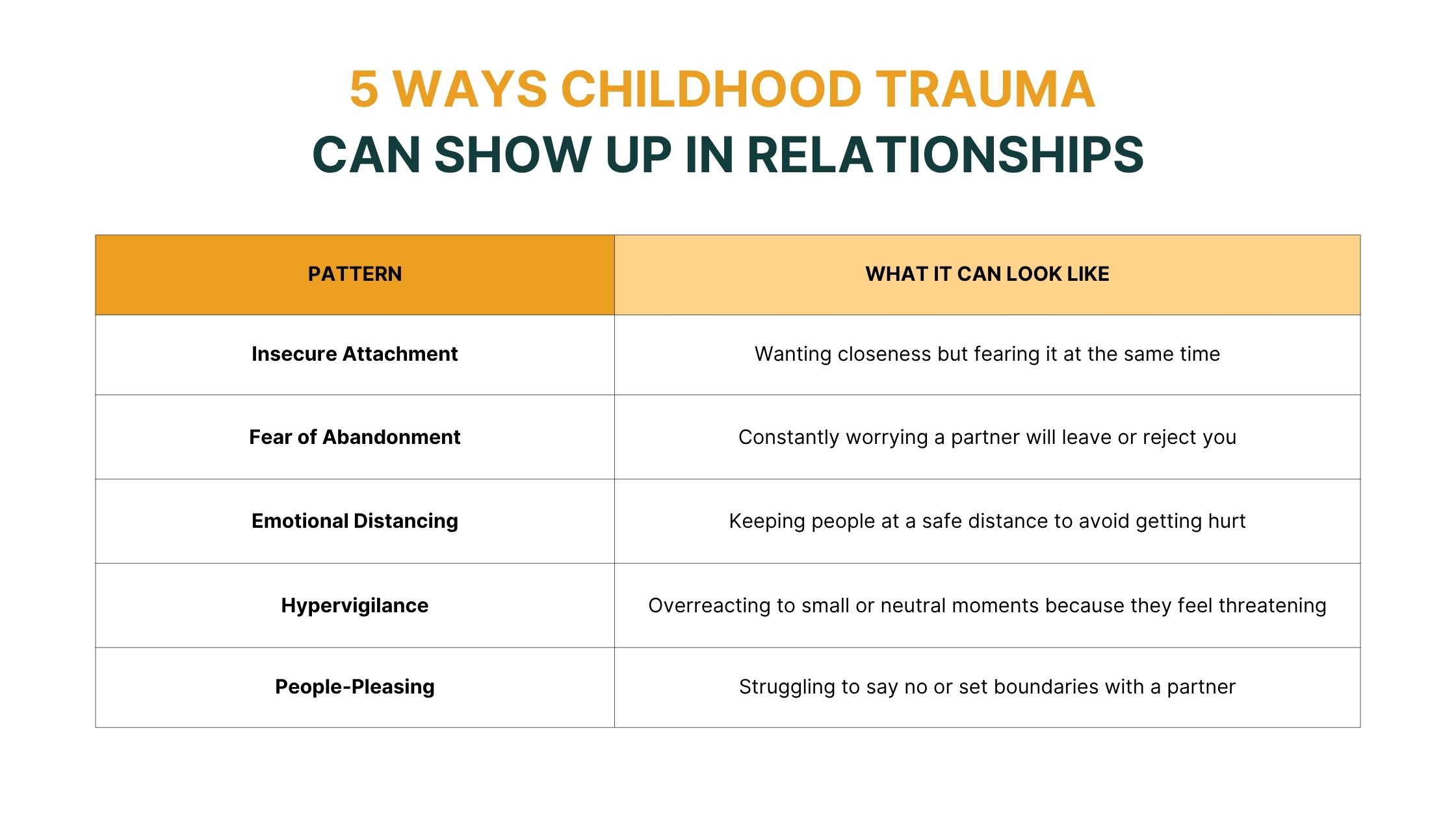
Trust and attachment issues rooted in childhood trauma typically fall into three patterns: insecure attachment, fear of abandonment, and emotional distancing. Each pattern developed as a survival response and now shapes how a person relates to a partner decades later.
- Insecure attachment develops when early caregiving was unpredictable, leading to anxious, avoidant, or disorganized attachment styles in adulthood. This creates confusion between wanting closeness and fearing it, which can look like pulling a partner in and pushing them away in the same week.
- Fear of abandonment shows up as constant worry that a partner will leave or reject them, sometimes triggering clingy behavior or unconscious testing, like picking fights to see if the other person will stay.
- Emotional distancing is the opposite defense: keeping a partner at a permanent, safe distance to avoid future hurt. This often gets mistaken for independence when it’s actually a protective habit built long before the relationship began. Patients working through this pattern often benefit from structured trauma therapy that addresses the nervous system response directly, not just the relationship behavior on the surface.
Emotional Triggers in Relationships: Recognizing the Patterns
Emotional triggers in relationships are moments when a partner’s ordinary behavior activates an outsized reaction rooted in childhood trauma rather than the present situation. A raised voice, a canceled plan, or even silence can trigger a response that feels far larger than the moment itself.
These emotional triggers in relationships often follow a predictable sequence: a small cue reminds the nervous system of an old unsafe pattern, the body responds as if the original threat is happening again, and the reaction, whether it’s shutting down or lashing out, arrives before conscious thought can catch up. Learning to name a trigger in the moment (“this is my nervous system reacting to something old, not to what’s actually happening right now”) is one of the most effective tools I teach patients working through childhood trauma in adults, because it creates a pause between the trigger and the reaction.
Recognizing Your Own Patterns: A Quick Checklist
Use this checklist to notice where childhood trauma may be shaping your current relationship patterns:
- Do you assume a partner is upset with you before they’ve said anything?
- Do you feel an urge to end relationships before the other person can leave first?
- Do you struggle to say no, even when a request feels unfair?
- Do minor conflicts trigger a reaction that feels bigger than the moment calls for?
- Do you feel most comfortable when a partner keeps some emotional distance?
Answering yes to two or more of these is a strong signal that childhood trauma, not the current relationship, is driving the pattern. If some of these signs sound familiar and you’ve noticed them repeating across more than one relationship, it may be worth learning how to find the right trauma therapist rather than assuming the pattern will resolve on its own.
| Pattern | Root Cause | Adult Relationship Impact |
| Insecure attachment | Unpredictable early caregiving | Confusion between wanting and fearing closeness |
| Fear of abandonment | Early loss, neglect, or inconsistency | Clinginess or unconscious testing behavior |
| Emotional distancing | Repeated early hurt | Avoiding vulnerability, mistaken for independence |
| Hypervigilance | Growing up in an unsafe or unpredictable environment | Overreacting to neutral or minor moments |
| People-pleasing | Survival tactic with a volatile caregiver | Difficulty setting boundaries with a partner |
Healing Childhood Trauma and What Trauma Recovery Looks Like
Healing childhood trauma starts with naming the pattern before trying to change the behavior, then working with a clinician trained in trauma to address the root cause rather than just the symptom sitting on top of it. Awareness alone won’t undo years of conditioning, but it interrupts the automatic reaction long enough to choose a different response.
Trauma recovery isn’t a single appointment or a fixed timeline; it’s a process that typically combines talk therapy, nervous system regulation work, and, for some patients, medication support when anxiety or depression symptoms are severe enough to interfere with daily functioning. Some patients benefit from contemporary Freudian psychoanalysis, which explores the unconscious roots of a pattern rather than treating a single symptom in isolation, while others do better with structured, solution-focused psychotherapy aimed at specific relationship goals. Both paths toward trauma recovery share the same outcome: replacing an old survival response with a choice that fits the relationship you actually have now, not the one you grew up in. For readers ready to take that step, this look at finding the right trauma therapist in Harrison, NY is a practical place to start.
Conclusion
Childhood trauma shapes adult relationships through attachment, trust, and emotional triggers, but none of those patterns are permanent. With the right support, insecure attachment can move toward security, hypervigilance can settle, and boundaries can be set without guilt. If you’ve recognized yourself in these patterns, that recognition is already the beginning of change. Book a consultation with Dr. Barbara Fontane to start building the healthier relationship dynamics you deserve.
FAQ
How does childhood trauma affect adult relationships?
Childhood trauma disrupts a person’s early sense of safety and trust, which carries into adulthood as insecure attachment, fear of abandonment, or emotional distancing. These patterns often repeat across relationships until they’re recognized and addressed through trauma-focused treatment.
Can childhood trauma affect romantic relationships?
Yes. Romantic relationships tend to activate attachment patterns more intensely than other relationships because they involve closeness and vulnerability. Childhood trauma often shows up as jealousy, fear of abandonment, or emotional shutdown specifically within romantic partnerships.
How do childhood experiences influence relationship patterns?
Early experiences teach the nervous system what to expect from closeness, whether that’s safety or unpredictability. Those lessons become templates that adults unconsciously apply to new relationships, often repeating the same dynamic until the pattern is identified and addressed.
Can therapy help with childhood trauma and relationship problems?
Yes. Trauma-informed therapy and, when appropriate, psychiatric care help identify the root pattern behind relationship struggles rather than just managing symptoms. Many patients see meaningful improvement in trust and communication within a few months of consistent treatment.
What are the effects of childhood trauma in adults?
The effects of childhood trauma in adults often include hypervigilance, difficulty trusting others, people-pleasing, and trouble regulating emotions during conflict. These effects can also extend beyond relationships into anxiety, depression, and physical stress responses.