Overview:
Choosing the right psychiatrist in Westchester County involves more than checking credentials or insurance networks. This guide explains the differences between psychiatrists and therapists, when to seek psychiatric care, and what to expect during your first appointment. It also covers medication management, psychotherapy, and how to evaluate whether a provider is the right fit for your needs. You’ll learn about different care options available across Westchester County, including private practices and hospital-affiliated programs, so you can make an informed decision. Whether you’re dealing with anxiety, depression, or other mental health concerns, this guide helps you confidently navigate your search for quality psychiatric care.
Table of Contents:
- Introduction
- What’s the Difference Between a Psychiatrist and a Therapist?
- When Should I See a Psychiatrist?
- How Do I Know if a Psychiatrist Is the Right Fit for Me?
- What Questions Should I Ask During My First Appointment?
- Does a Psychiatrist Provide Therapy and Medication Management?
- Comparing Your Options in Westchester County
- Closing Thoughts
Introduction
Finding a psychiatrist in Westchester County often starts with a Google search and ends with a long list of names, none of which tell you much about who the person actually is. Directories can filter by insurance and specialty, but they cannot tell you whether a provider will listen closely, explain a diagnosis in plain language, or make you feel rushed after fifteen minutes. That part of the search takes a different kind of research, one that this guide is built to walk you through.
Westchester also has a real access problem worth naming upfront. According to New York State’s Department of Health and Office of Mental Health, the Hudson Valley region has just 15.7 psychiatrists per 100,000 residents, compared to a statewide average of 36 per 100,000 (NYS DOH/OMH regulatory waiver response). That shortage is part of why so many strong providers in this county run private practices and stay out-of-network. Knowing this before you start calling offices will save you frustration later.
What’s the Difference Between a Psychiatrist and a Therapist?
A psychiatrist is a medical doctor who can diagnose mental health conditions, prescribe medication, and order lab work, while a therapist provides talk-based treatment without prescribing authority. Both can offer psychotherapy, but only a psychiatrist can manage medication alongside it.
This distinction confuses a lot of first-time patients, and it’s worth sitting with for a moment. A psychiatrist completes medical school and a residency in psychiatry, which means they are trained to look at a symptom picture through both a biological and psychological lens. A therapist, whether a licensed clinical social worker, psychologist, or counselor, focuses on the therapeutic relationship and behavioral or emotional treatment. Many patients see both: a psychiatrist for evaluation and medication and a therapist for ongoing weekly sessions. For a deeper breakdown of how these two roles work together, our team put together a full comparison in psychiatrist vs. therapist, which covers when you might need one, the other, or both at once.
When Should I See a Psychiatrist?
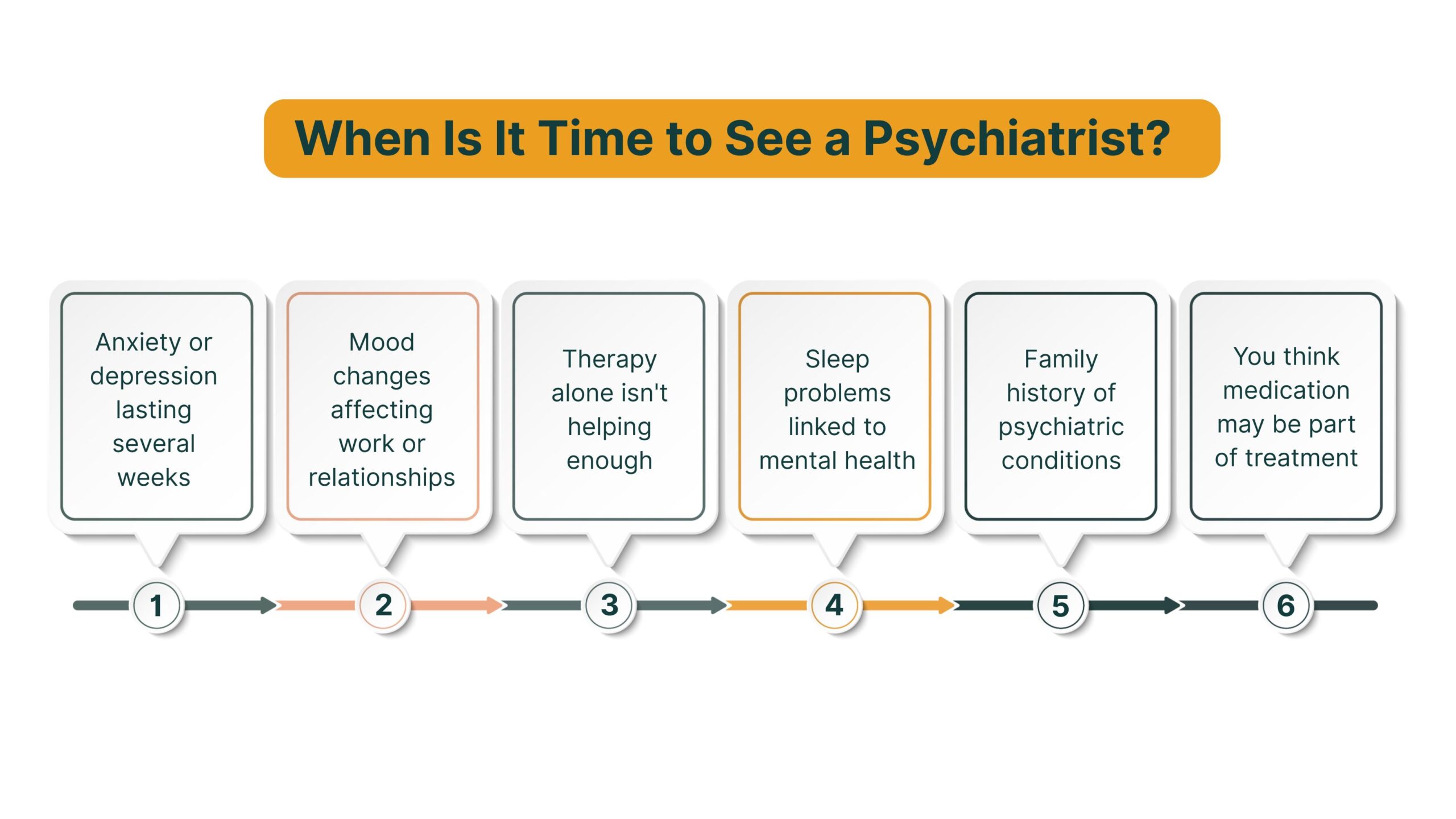
See a psychiatrist when symptoms interfere with daily functioning, when therapy alone hasn’t produced enough change, or when a condition may have a biological component that medication can address. This includes persistent anxiety, depression, mood swings, sleep disruption, or a family history of psychiatric illness.
It’s a myth that a person needs to be in crisis before booking a psychiatric appointment. Most patients I see are functioning reasonably well on the surface, going to work, managing their households, but privately exhausted by a level of anxiety or low mood that has outlasted their own coping tools. If you’ve noticed that a difficult period has stretched past a few weeks without easing, that’s a fair signal to schedule a psychiatric evaluation rather than wait for things to escalate.
How Do I Know if a Psychiatrist Is the Right Fit for Me?
The right fit is a psychiatrist who explains their reasoning clearly, answers questions without making you feel rushed, and adjusts their approach based on your goals rather than a one-size-fits-all protocol. Fit matters as much as credentials because treatment adherence depends on trust.
One pattern I’ve noticed after years of first-time consultations: patients rarely leave a bad fit because of a wrong diagnosis. They leave because they felt unheard, or because the appointment felt transactional, ten minutes, a prescription, and a follow-up date with no real conversation in between. A psychiatrist who takes a full history, asks about your life circumstances and not just your symptom list, and checks in on how a treatment plan is actually landing for you is usually the one worth staying with. If you’re weighing a longer-term relationship with a provider, particularly for a chronic or recurring condition, it’s worth reading how continuity of care shapes outcomes in our piece on chronic mental health care.
What Questions Should I Ask During My First Appointment?
Ask about the psychiatrist’s approach to diagnosis, how they combine medication with therapy, what a typical treatment timeline looks like, and how they handle appointment availability between visits. These questions reveal more about fit than a bio page ever will.
A short list to bring to your first consultation:
- What is your process for reaching a diagnosis?
- Do you offer medication management, psychotherapy, or both?
- How often will we meet, and how will that change over time?
- What happens if a medication isn’t working as expected?
- How do you handle questions or concerns between scheduled appointments?
- Are you in-network with my insurance, or do you provide superbills for out-of-network reimbursement?
Does a Psychiatrist Provide Therapy and Medication Management?
Some psychiatrists provide both psychotherapy and medication management in the same practice, while others focus solely on medication and refer patients to a separate therapist. This varies by provider, so it’s worth confirming directly rather than assuming.
| Care Model | What It Includes | Best For |
| Medication-only psychiatrist | Diagnosis, prescribing, medication follow-up | Patients already in therapy elsewhere |
| Combined psychiatrist | Diagnosis, prescribing, and ongoing talk therapy with the same provider | Patients who prefer one consistent relationship |
| Psychiatrist + separate therapist | Split care between two providers who coordinate | Patients with complex or long-term needs |
A combined approach, where one provider manages both the medical and therapeutic side of treatment, tends to reduce the gaps that come from two providers who aren’t in regular contact with each other. It’s one reason patients often ask specifically about practices offering psychotherapy in Harrison, NY alongside medication management, rather than piecing together care from two unconnected offices.
Comparing Your Options in Westchester County
Beyond individual providers, patients generally choose between three paths: private practice directories, hospital-affiliated programs, and county mental health resources.
| Option | Cost | Typical Wait Time | Best Fit |
| Private practice (via directory) | Often out-of-network, higher upfront cost | Days to a few weeks | Patients wanting longer sessions and continuity |
| Hospital-affiliated program | Usually in-network | Several weeks | Patients needing coordinated, multi-specialty care |
| County mental health resources | Sliding scale or low-cost | Varies, often longer | Patients prioritizing affordability |
Closing Thoughts: Get in Touch with Right Psychiatrist in Westchester County
Choosing a psychiatrist Westchester County is less about finding the most credentialed name on a list and more about finding someone whose approach matches how you want to be treated, medically and personally. Take the time to ask questions, notice how a first conversation feels, and trust that a good fit is worth the extra search.
If you’re ready to take the next step, schedule a consultation with Dr Barbara Fontane (psychiatrist Westchester County NY) to talk through what care could look like for you.
Frequently Asked Questions
How do I find the right psychiatrist in Westchester County?
Start by identifying whether you need medication management, therapy, or both, then filter local providers by specialty, insurance, and location. From there, book a consultation and use it to gauge communication style before committing to ongoing care.
What should I look for when choosing a psychiatrist?
Look for clear communication, a thorough evaluation process, and a treatment approach that adapts to your goals rather than following a fixed protocol. Credentials matter, but how a provider listens during your first conversation matters just as much.
Can a psychiatrist help with anxiety and depression?
Yes. Psychiatrists diagnose and treat anxiety treatment and depression through a combination of medication, psychotherapy, or both, depending on symptom severity and patient preference.
What happens during a psychiatric evaluation?
A psychiatric evaluation typically includes a detailed history of symptoms, family and medical background, and a discussion of how symptoms affect daily functioning. It usually takes 45 to 60 minutes and forms the basis of a treatment plan.