
Overview:
Wondering whether you need therapy or simply a break is more common than you might think. This guide explains how to distinguish temporary stress from emotional challenges that may benefit from professional support. It explores the signs that therapy may be helpful, when self-care is no longer enough, and how therapy differs from taking time to rest. You’ll also learn how persistent changes in mood, sleep, relationships, or daily functioning can signal the need for mental health support. Whether you’re feeling emotionally exhausted or uncertain about your next step, this guide offers practical insights to help you make an informed decision about seeking therapy.
Table of Contents:
- Introduction
- Signs That Therapy May Be Helpful
- When Taking a Break Isn’t Enough
- Therapy vs. Self-Care for Emotional Wellbeing
- How to Know If Emotional Challenges Require Therapy
- Closing Thoughts
Introduction
Most people ask this question “should I go to therapy” at the exact moment they’re too tired to answer it clearly. You’ve had a hard few weeks, maybe months, and you’re trying to figure out if a long weekend will fix it or if something more is going on underneath. The honest answer is that the two paths look similar on the surface and feel very different once you sit with them for a moment.
According to the American Psychiatric Association’s 2026 Healthy Minds Poll, stress and sleep remain the two factors Americans cite most often as affecting their mental health, and 65% of respondents said they had never spoken with a healthcare professional about their own mental health at all (APA, 2026). That gap between what people are carrying and what they’ve actually addressed out loud is where the need for mental health support usually shows up first, quietly, long before someone decides to act on it.
Signs That Therapy May Be Helpful
Therapy is likely helpful when your emotional reactions feel disproportionate to what’s in front of you, when you keep repeating the same relationship patterns, or when daily functioning, like sleep, appetite, or work performance, has noticeably declined. These are not signs of weakness. They’re signs your nervous system is asking for support it hasn’t gotten yet.
Signs you need therapy tend to cluster in a few recognizable ways. You might notice anger, tears, or withdrawal that feels bigger than the situation warrants, or find yourself back in a version of the same toxic dynamic you swore you’d left behind. You might struggle to get out of bed some mornings, or notice you’re eating far more or far less than usual. And you might catch yourself reaching for doom-scrolling, substances, or other forms of escapism just to avoid sitting with your own thoughts. Any one of these on its own can be situational. A few of them together, sustained over weeks, usually points to something that talk alone in your own head hasn’t been able to resolve.
When Taking a Break Isn’t Enough
A break isn’t enough when the relief it provides is temporary and the underlying distress returns within days of going back to normal life. If a weekend off restores your energy but the same heaviness reappears by Tuesday, the problem was never really about rest.
This is the part most self-help content skips. A break works well for emotional exhaustion symptoms tied to a specific, time-limited stressor, a hard project, a family event, a demanding season. It does not work as well when the exhaustion has no clear edges, when you can’t point to a single cause, or when you’ve tried rest before and it only bought you a few good days. In my practice, this is one of the more common patterns I see: someone tells me they’ve taken three or four “breaks” over the past year, each one helping less than the last. That pattern itself is diagnostic. It tells you the fatigue was never purely situational.
Therapy vs. Self-Care for Emotional Wellbeing
Self-care supports emotional wellbeing day to day, while therapy addresses the deeper patterns, trauma, or clinical symptoms that self-care alone cannot resolve. The two are not competing options. Self-care is maintenance. Therapy is treatment.
It helps to think of this less as a fork in the road and more as two tools that work on different problems. A hobby, a walk, a good night’s sleep, these restore your baseline when your baseline is intact. But if the baseline itself has shifted, if you’re anxious even on good days, or numb even when nothing is technically wrong, self-care will not move that baseline back. That’s where you need psychotherapy, and for some patients, a combination of therapy and medication management addresses both the emotional pattern and any biological component underneath it.
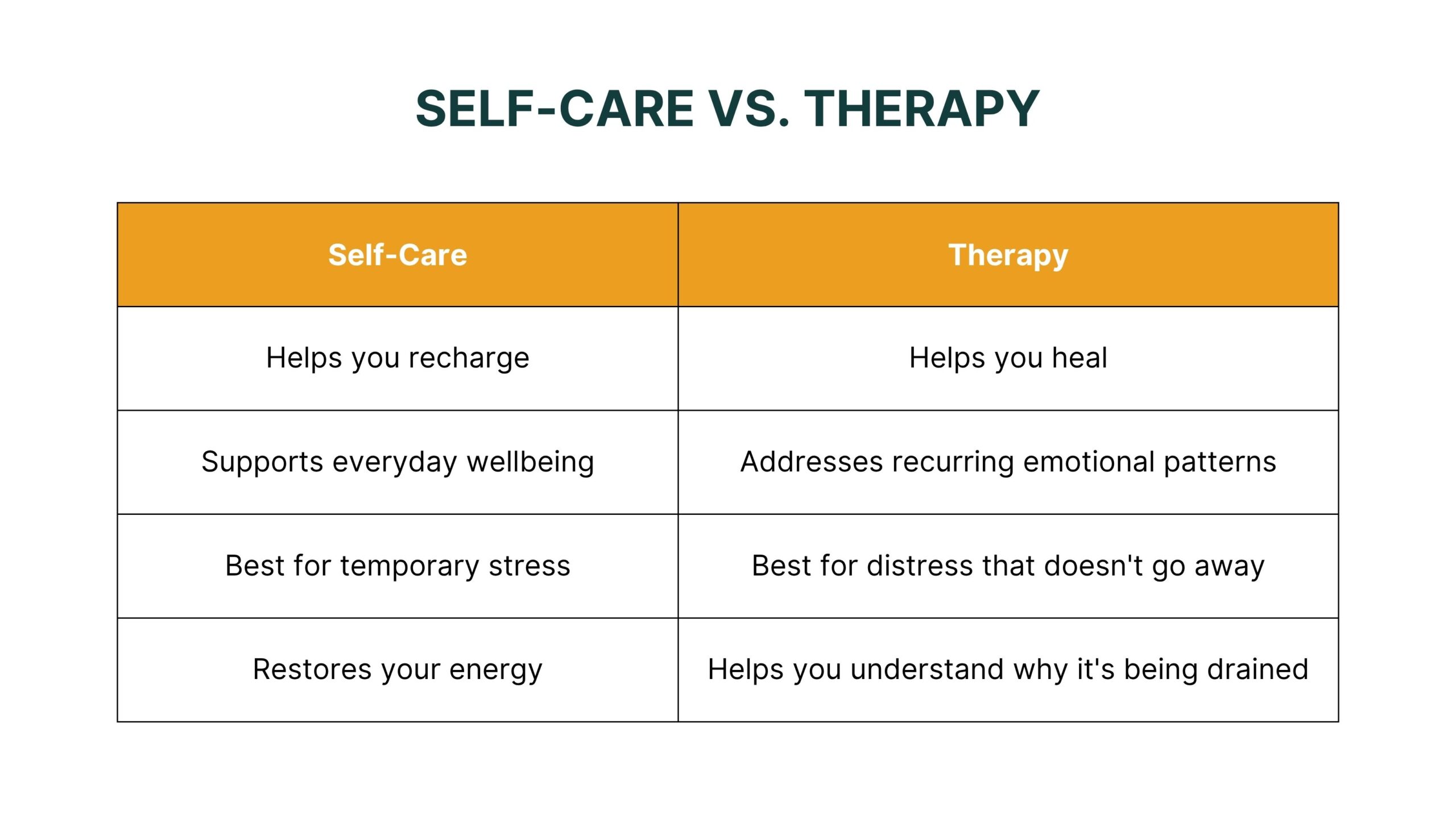
| Approach | What It Addresses | Best Suited For |
| Self-care (rest, hobbies, time off) | Situational fatigue, short-term overwhelm | Temporary stress with a clear cause |
| Therapy | Recurring patterns, trauma, disproportionate emotional responses | Distress that persists past the situation |
| Therapy + medication management | Clinical symptoms with a biological component | Anxiety or depression affecting daily functioning |
How to Know If Emotional Challenges Require Therapy
Emotional challenges require therapy when they persist without a clear external cause, when they interfere with work, relationships, or basic functioning, or when they’ve resisted your own coping efforts for more than a few weeks. If you’re unsure, that uncertainty itself is worth bringing to a professional rather than resolving alone.
A short self-check can help clarify where you stand before you decide on a next step:
- Has this feeling lasted more than two to three weeks without easing?
- Can you point to one clear, temporary cause, or does it feel like it’s coming from everywhere at once?
- Has rest or time off helped before, and did the relief last?
- Are you noticing changes in sleep, appetite, or your ability to concentrate at work?
- Have you found yourself avoiding thoughts or feelings rather than processing them?
If you answered yes to two or more of these, particularly numbers one, two, and five, that’s a reasonable signal to seek a psychiatric evaluation or begin a conversation with a therapist rather than waiting it out. Tools like Psychology Today’s therapy self-assessment can offer an early gut check, though a conversation with a licensed provider will always give you a clearer picture than any quiz can.
Left unaddressed, this kind of unresolved pattern rarely stays the same size. It tends to widen, showing up in relationships, at work, and in physical symptoms like sleep disruption or chronic tension, particularly when the root cause involves earlier trauma. If that sounds familiar, our guide on finding the right trauma therapist in Harrison, NY walks through what that specific search looks like.
Closing Thoughts: Therapy or Break
Whether you land closer to “I need a break” or “I need support,” both are valid starting points, and neither one requires you to have it all figured out before reaching out. If you’re still unsure where you stand, a conversation with a professional can offer more clarity than another self-assessment ever will to understand the benefits of therapy.
If that sounds like where you are right now, schedule a consultation with Dr Barbara Fontane (psychiatrist in Westchester County) to talk through what’s actually going on and what kind of support fits.
Frequently Asked Questions
How do I know if I need therapy or just need a break?
If relief from rest is temporary and the same distress returns once normal life resumes, therapy is likely the better fit. A break works best for short-term, situational fatigue with a clear cause.
When does stress become a mental health concern?
Stress becomes a mental health concern when it persists beyond the situation that caused it, disrupts sleep or appetite, or begins affecting work and relationships. At that point, it has moved past ordinary stress into something that benefits from professional support.
Do I need therapy for anxiety and stress?
Not always immediately, but if anxiety is frequent, disproportionate to circumstances, or interferes with daily functioning, therapy and possibly medication management can address it more effectively than self-care alone.
How do I tell if you need professional mental health support?
Persistent low mood, disproportionate emotional reactions, declining functioning, and reliance on unhealthy coping habits are the clearest signs. If two or more of these have lasted several weeks, it’s worth speaking with a professional.