Overview
Racing thoughts, trouble finishing tasks, restless nights. These experiences can point to anxiety, ADHD, or both, which is exactly why so many people ask, is it anxiety or ADHD? The two conditions share several surface symptoms, but they come from different places in the brain and respond to different kinds of care. This blog breaks down the difference between anxiety and ADHD in plain language, covering focus, restlessness, timeline, and adult presentations, so you can better understand what you are experiencing and when it makes sense to talk to a mental health professional.
Table of Contents
- Introduction
- Focus and Thinking Patterns
- Restlessness and Energy Levels
- Timeline: When Symptoms First Appear
- Adult ADHD Symptoms vs Anxiety Symptoms
- Can You Have ADHD and Anxiety at the Same Time?
- When to Seek a Professional Evaluation
- Final Thoughts: How Treatment for ADHD and Anxiety Works
- FAQs
Introduction
Why Anxiety vs ADHD Get Mixed Up? Anxiety symptoms and ADHD symptoms can look nearly identical from the outside: trouble concentrating, restlessness, irritability, sleep that never feels restful. Both can make a person feel scattered, on edge, and exhausted by the end of the day. But ADHD and anxiety are not the same condition wearing different clothes. One is a difference in how the brain manages attention. The other is a response to fear and perceived threat. Telling them apart matters, because the difference between anxiety and ADHD shapes which treatment for ADHD and anxiety will actually help.
Focus and Thinking Patterns
This is often the clearest place to start when comparing ADHD vs anxiety symptoms.
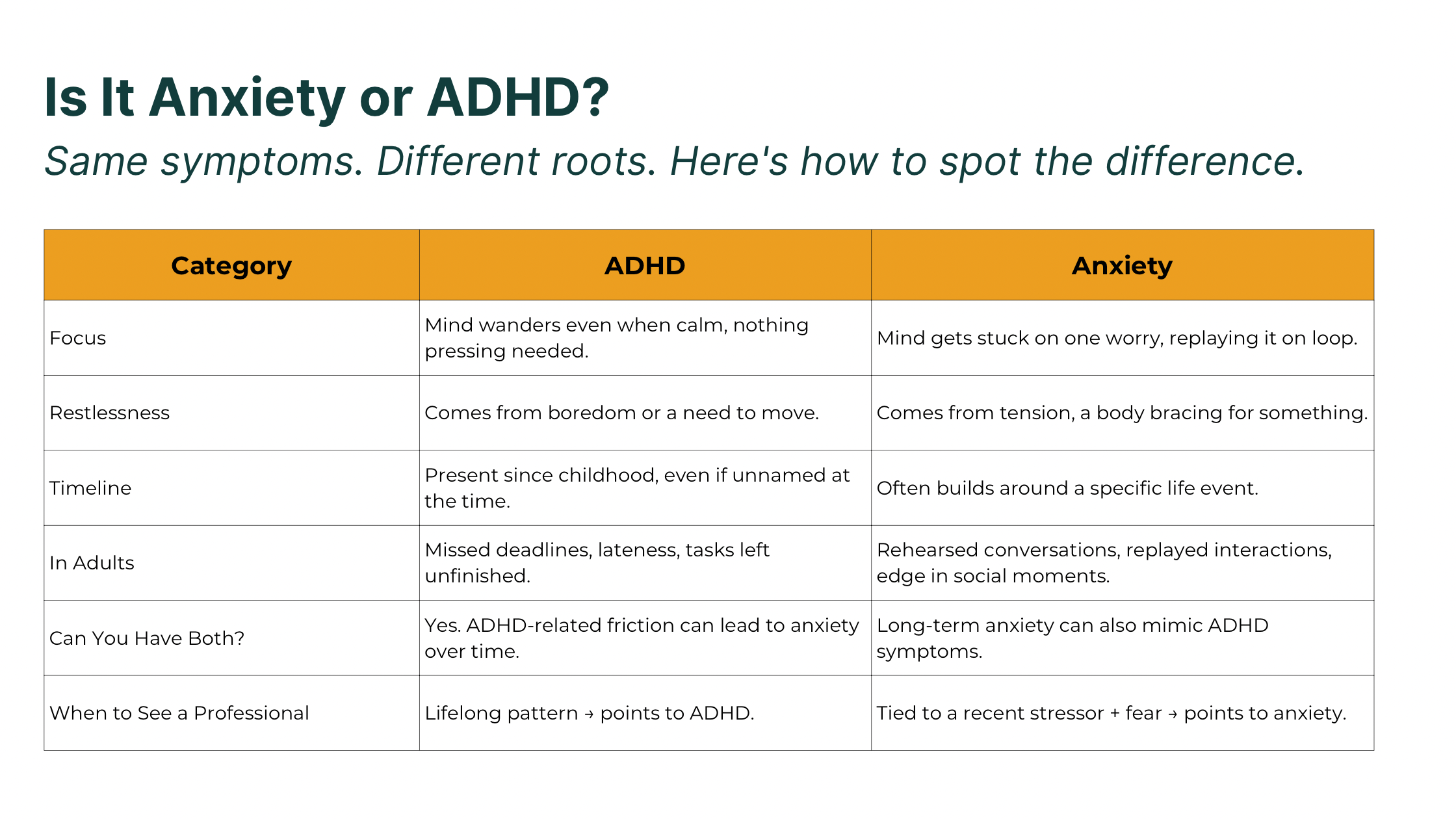
With ADHD, trouble focusing happens even in a calm, low-pressure moment. The brain has a hard time filtering out distractions or holding attention on one task, regardless of how relaxed or motivated a person feels. Even a slow, unhurried afternoon with nothing pressing can still end in an unfinished to-do list, simply because the mind keeps wandering toward whatever is more stimulating in the moment.
With anxiety, the loss of focus comes from somewhere else. The mind is not wandering for stimulation; it is overloaded with specific worries, fears, or worst-case scenarios that crowd out everything else. A person with anxiety might reread the same paragraph five times because a single worry, about a deadline, a relationship, or a health concern, keeps looping through their thoughts.
Recognizing this distinction is one of the fastest ways to answer the question, can ADHD be mistaken for anxiety? Ask what is actually happening when focus slips: is the mind chasing something new and interesting, or is it stuck on a specific fear? That single question often points toward an answer.
Restlessness and Energy Levels
Fidgeting, pacing, and a general sense of being unable to sit still show up in both conditions, which is part of why they are so often confused.
In ADHD, restlessness tends to come from an internal drive for movement, or from plain boredom. The body wants to move because stillness itself feels uncomfortable, not because anything specific is wrong. Tapping a foot during a meeting, getting up to walk around, or needing background noise while working are common examples.
In anxiety, restlessness has a different source. It comes from being tense, nervous, or on edge, usually tied to racing or fearful thoughts. The body is bracing for something, even if that something is hard to name. Someone with anxiety might describe a tight chest, a churning stomach, or a general sense of dread that keeps them from settling into a chair or a conversation.
Both patterns are real, and both deserve support. The goal here is not to diagnose yourself but to notice which description feels closer to your own experience, since that noticing is often the first step toward the right kind of help.
Timeline: When Symptoms First Appear
History matters as much as the symptoms themselves. ADHD is a lifelong pattern. Disorganization, forgetfulness, and distractibility connected to ADHD are typically present from early childhood, even if they were not recognized or named at the time. Many adults look back at report cards or old memories and realize the same patterns, losing track of time, misplacing things, struggling to sit through long tasks, were there all along.
Anxiety, on the other hand, often builds or peaks around specific life events. A new job, a health scare, a major loss, or a stretch of high pressure at home can bring anxiety symptoms to the surface later in life, sometimes for the first time. This timeline is one of the more reliable ways to work out how to tell the difference between anxiety and ADHD: ask whether the pattern has always been there, or whether it arrived alongside a particular chapter of life.
For anxiety that seems to run deeper than a single event, one that keeps circling back in different forms over the years, contemporary Freudian psychoanalysis can help uncover the roots of that pattern rather than just naming the trigger in front of you.
Adult ADHD Symptoms vs Anxiety Symptoms
Adult ADHD symptoms often look different from the hyperactive stereotype many people picture from childhood. In adults, ADHD can show up as chronic lateness, missed deadlines, trouble managing finances, or a mind that jumps between tasks without finishing any of them. It can also bring a quieter kind of restlessness, an inner sense of always being behind or rushed, even when nothing urgent is actually happening.
Anxiety in adults tends to center more on worry itself: rehearsing conversations before they happen, replaying past interactions, or feeling physically on edge in social or high-stakes situations. Some people also experience anxiety connected to burnout, where prolonged stress at work starts to mimic anxious symptoms, and untangling the two takes a closer look, since the causes and the care differ.
Understanding ADHD vs anxiety in adults is about noticing patterns over time, across different areas of life, work, relationships, sleep, and mood, rather than judging a single hard day. Adults who are also managing ADHD alongside OCD often notice this same blurring between attention difficulties and anxious thought loops.
Can You Have ADHD and Anxiety at the Same Time?
Yes, and it happens often. Research and clinical experience both point to significant overlap: many people with ADHD develop anxiety as a secondary response to the daily friction that undiagnosed ADHD creates, missed deadlines, forgotten commitments, strained relationships. Over time, that friction can produce real, persistent worry, even in someone whose underlying attention difficulties are the primary issue.
The reverse can happen too. Long-standing anxiety can make it harder to concentrate, plan, and follow through on tasks, mimicking some of the outward signs of ADHD without the same lifelong developmental history behind it.
This overlap is exactly why a proper evaluation matters so much. The ADHD non-profit ADDA has written extensively about how these two conditions intersect and why they are so often mistaken for one another. Self-diagnosis based on a symptom list rarely captures the full picture, especially when both conditions are present together.
When to Seek a Professional Evaluation
A few signs suggest it is time to talk to a mental health professional rather than continuing to guess. If symptoms have been present since childhood and have shaped school, work, or relationships over many years, that points toward a possible ADHD evaluation. If symptoms are newer, tied to a specific stressor, and come with a strong undercurrent of fear or dread, that leans more toward anxiety, though it is not always so clean-cut.
If daily life feels consistently harder than it should, focus, follow-through, sleep, mood, and self-worth, it is worth having a full evaluation rather than trying to sort out the cause alone. A trained clinician can look at history, current symptoms, and how they interact, rather than relying on a single conversation or an online checklist. For anyone whose anxiety is tangled up with a history of trauma, that connection is worth naming before an evaluation, since it can change what treatment for ADHD and anxiety ends up looking like. Depending on what the evaluation uncovers, care can range from therapy alone to thoughtful medication management alongside it.
Final Thoughts: How Treatment for ADHD and Anxiety Works?
Getting an accurate diagnosis is the foundation for everything that follows, because treatment for ADHD and anxiety is not one-size-fits-all. In my practice, I combine evidence-based psychiatry with psychodynamic talk therapy, looking for the root causes behind a person’s symptoms rather than managing them on the surface alone. For some patients, that means solution-focused psychotherapy built around specific, individual goals. For others, it means a longer-term process that pairs talk therapy with medication or deeper analytic work, depending on what the evaluation shows.
Every evaluation is comprehensive, and for patients considering bariatric surgery, that includes the required pre-surgical psychological assessment as part of a broader picture of mental health.
Anxiety and ADHD can overlap in ways that make self-diagnosis unreliable, and that is completely understandable given how similar the symptoms can feel from the inside. If you are still asking yourself whether it is anxiety, ADHD, or both, the clearest next step is a comprehensive psychiatric evaluation. Schedule a visit with Dr. Barbara Fontane to get an accurate diagnosis and a treatment plan built around what your mind and body actually need.
FAQs
How can I tell if my symptoms are caused by anxiety or ADHD?
Look at when the symptoms started and what triggers them. ADHD tends to be lifelong and present across many settings, while anxiety often centers on specific worries or life events. A professional evaluation is the most reliable way to know for certain.
Can anxiety and ADHD occur at the same time?
Yes. It is common for someone with ADHD to develop anxiety over time, and for chronic anxiety to make attention and focus harder to manage. A full evaluation can determine whether one, both, or neither condition is present.
Why are ADHD and anxiety often confused with each other?
Both conditions can cause trouble concentrating, restlessness, and disrupted sleep. The underlying cause is different, brain-based attention regulation for ADHD versus fear and worry for anxiety, but the outward symptoms can look strikingly similar day to day.
What are the biggest differences between ADHD and anxiety symptoms?
ADHD symptoms are usually present from childhood and show up regardless of stress levels. Anxiety symptoms tend to appear or intensify around specific triggers and are driven by persistent worry rather than difficulty filtering distractions.
When should I seek a professional evaluation for anxiety or ADHD?
If symptoms are affecting your work, relationships, or daily functioning, or if you are unsure whether what you are feeling is worry, distraction, or both, it is time to speak with a mental health professional for a full evaluation.